
BugHerd reviews tend to be positive, and for good reason. The pinned feedback with automatic metadata is genuinely useful for teams running a manual QA pass. Where things get more complicated is when you need QA to happen on its own, or when per-seat pricing starts adding up across a bigger team. We'll break down the pricing, the gaps, and a few alternatives worth considering.
TLDR:
- BugHerd scores 4.7/5 on G2 but has no automated QA layer, so every issue still requires a human to find it first.
- BugHerd's Basic plan starts at $50/month (5 members included, $10 per extra member on monthly billing) or $41/month on annual billing ($8 per extra member), which adds up fast for larger agency teams.
- BugHerd has no per-client memory and no verified client approval gate, leaving those gaps for your team to fill manually.
- If your dev team lives in Jira, BugHerd or Marker.io fit that workflow better than most alternatives right now.
- Superflow runs AI QA agents on every deploy, carries brand memory across projects, and records client approvals via a link with no login required.
What Is BugHerd and How Does It Work?
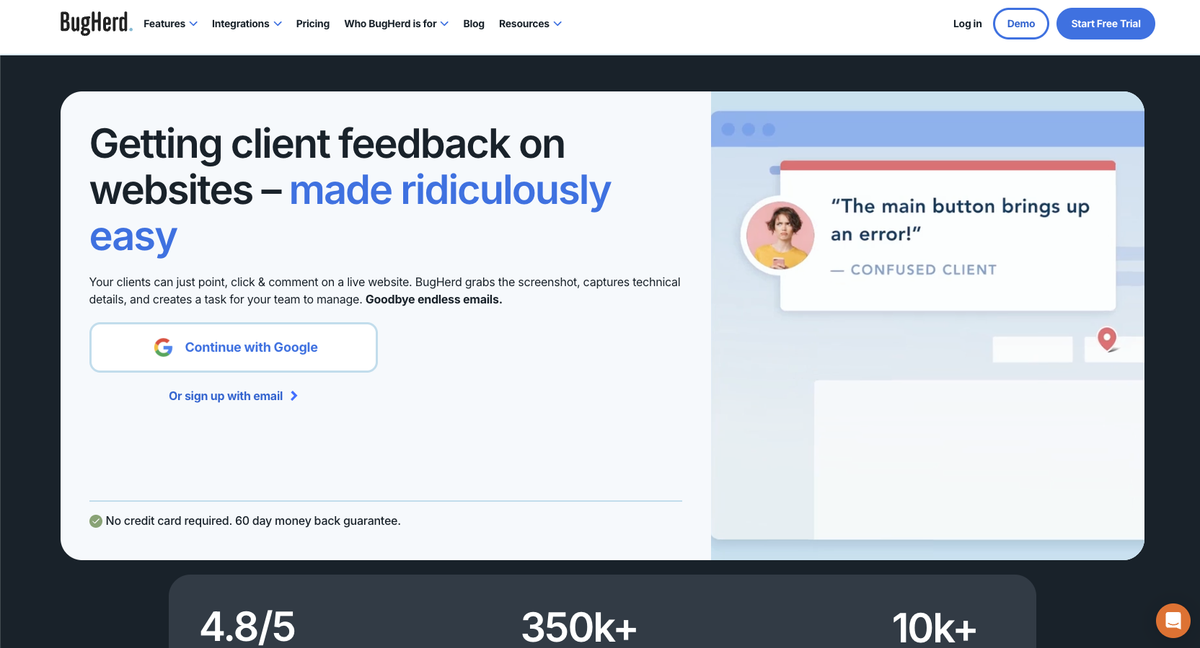
BugHerd is a visual website feedback tool built for agencies, QA teams, and developers who need clients to report issues directly on a live page. Instead of emailing vague descriptions, reviewers click on any element and leave a comment pinned to that exact spot.
What makes it useful is what gets captured automatically. According to work-management.org's BugHerd review, every pin captures a screenshot, page URL, browser, operating system, screen resolution, and the specific page element: context that developers would otherwise have to chase down manually.
The core workflow looks like this:
- A reviewer installs the BugHerd sidebar or JavaScript snippet on the site
- They click on any element to leave a comment
- BugHerd converts that comment into a task on a built-in kanban board
- The team works through tasks, with two-way sync available for Jira, Asana, ClickUp, Monday.com, Trello, Linear, and more on the Pro plan
On G2, BugHerd holds a 4.7 out of 5 stars across 216 reviews, with 85% of reviewers giving it five stars. That score reflects genuine satisfaction with the core feedback loop.
BugHerd works well when a careful human is doing the reviewing. The tool captures what you find. Finding it is still your job.
Why Consider BugHerd Alternatives?
BugHerd earns its reputation for a reason. The metadata capture is genuinely good, Jira and Trello sync works, and the kanban board covers common task workflows without requiring a separate PM tool for straightforward projects. For teams running a careful human QA pass on straightforward sites, it holds up fine.
That said, a few gaps matter depending on your workflow.
- BugHerd has no automated QA layer. Every pin requires a person to first notice the issue, which means your review quality depends entirely on whoever is doing the clicking that day. If those gaps matter, see our roundup of the best BugHerd alternatives for agencies. There's no agent running a spell check or flagging broken links before the client sees the page.
- Pricing can also add up. BugHerd's Basic plan starts at $50/month, with extra members billed at $10 each on monthly billing or $8 each on annual billing. For agencies running several active projects across a larger team, the per-seat cost compounds faster than it looks at first glance.
- No per-client memory. Every project starts from scratch with no retained brand rules or past decisions carried forward.
- Formal client approval gate is unverified. If a recorded, multi-step sign-off matters to your workflow, BugHerd may not cover it.
None of these are dealbreakers for every team. But if you need QA to happen automatically, client sign-off to be documented, or brand knowledge to carry across projects, see how Superflow vs. BugHerd plays out feature by feature.
Best BugHerd Alternatives in August 2026
Superflow
Superflow is an AI-powered QA and review/approval platform for web and marketing agencies. Upload any QA checklist or brand guide and Superflow converts it into named AI agents that run automatically on every site change, posting findings as pinned comments on the exact element before any human has to look. Built-in agents cover Accessibility, Broken Links, Spell Check, and OG Images. Custom agents handle anything else on your checklist. Per-client Memory compounds across projects, so brand rules and past decisions learned on project one still apply on project ten. When the work is ready, clients approve via a shareable link with no account required. Five asset types supported: websites, video, PDF, Lottie, and images. The core gap BugHerd leaves open, running QA instead of just recording it, is what Superflow fills.
There are several other tools worth considering depending on your team's setup and workflow.
Atarim
Atarim has repositioned as an AI web agency platform with six named agents (Claro, Pixel, Navi, Index, Lexi, and Glitch) covering design, UX, SEO, content, bug fixes, and site checks. Automated workflows run on schedules and triggers as well as on demand, though there is no automatic trigger on every code deploy. Pricing is a flat $67/month Pro plan (or roughly $56/month on annual billing) covering up to 100 seats and 1,000 projects. Teams considering it should also review the best Atarim alternatives for agencies.
Marker.io
Strong fit for dev and QA teams. see how Superflow compares to Marker.io. The Starter plan ($39/mo annual) includes integrations with Trello, Asana, ClickUp, GitHub, GitLab, Linear, Monday, Basecamp, and more; Jira requires the Team plan ($149/mo annual). Website feedback only; no support for video, PDF, or images. Every QA pass still requires a person. Starts at $39/mo on annual billing with a 15-day trial.
Userback
Built for post-launch product feedback, not pre-launch delivery. Session replay, NPS surveys, and a feature voting portal make it a fit for product teams managing live applications. No pre-launch QA automation and no formal client approval workflow. Agencies delivering website builds will find the workflow mismatch hard to overlook.
SureFeedback
SureFeedback now ships in two forms. The primary product is SureFeedback Cloud, a subscription starting at $19-59/month (first-year pricing) that works across WordPress, Shopify, and plain HTML sites via a JavaScript snippet. The self-hosted WordPress plugin still exists at $99-169/year for teams that need data stored on their own server. Both versions include Page Approvals on all plans. No AI layer, and PM integrations are absent for now (Ottokit support is listed as coming soon). Best fit for teams wanting lightweight, affordable feedback collection without a heavy toolstack behind it.
Feature Comparison: BugHerd vs Top Alternatives
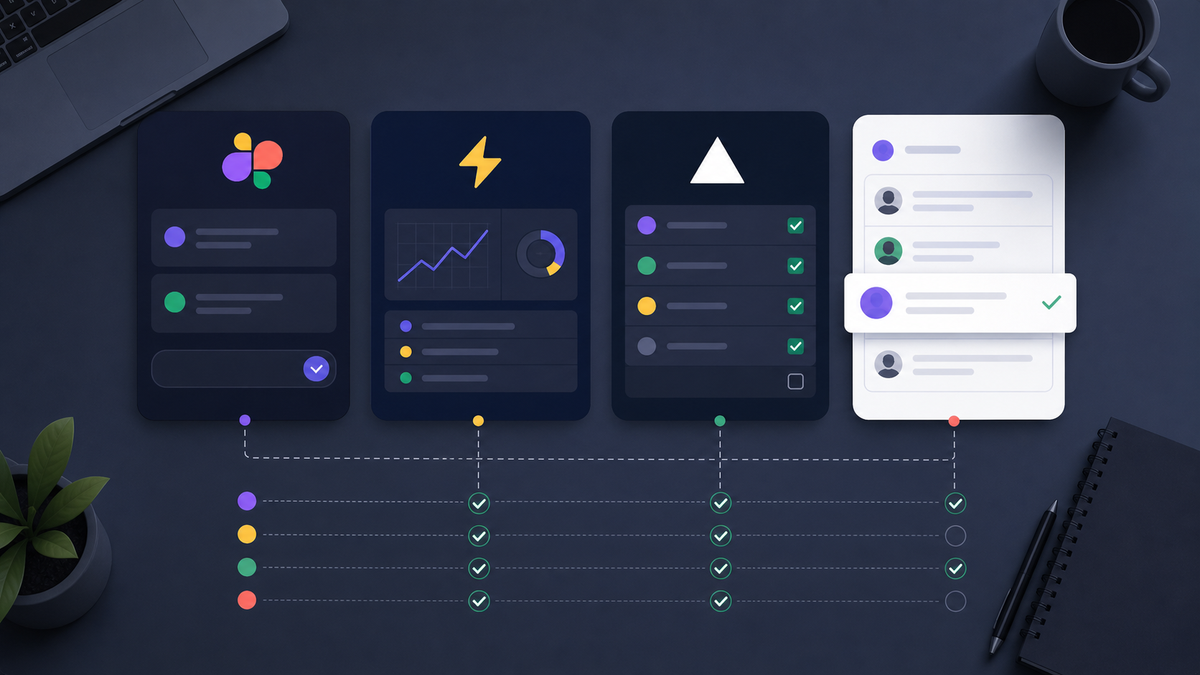
The table below puts the most-compared tools side by side across the features that actually decide buying decisions: QA automation, client approval flow, asset support, integrations, pricing, and compliance.
| Feature | BugHerd | Superflow | Atarim | Marker.io | Userback | SureFeedback |
|---|---|---|---|---|---|---|
| Automated QA agents | No | Yes, on every deploy | On demand, metered | No | No | No |
| Client approval (no login) | Not verified | Yes, link-based | Partial (internal only) | Not verified | Not verified | No |
| Per-client memory | No | Yes, compounds across projects | Partial (configured per project) | No | No | No |
| Multi-asset support | Websites only | Websites, video, PDF, Lottie, images | Websites only | Websites only | Websites only | Websites only |
| Two-way PM integrations | Jira, Trello | Asana, Monday, ClickUp, Jira, Trello (two-way sync) | Jira, Asana, ClickUp, Monday, Trello, Basecamp | Jira, GitHub, GitLab, Linear (Team plan+) | Jira, Linear, ClickUp | Zapier/Make only |
| Pricing model | $50-150/mo + $8/extra member | $0-34/seat/mo, guests free | $25-35/seat/mo, clients free | $39-149/mo annual, no free plan | $0-159/mo annual | $99-169 one-time license |
| SOC 2 / HIPAA | Not published | SOC 2 Type II, HIPAA with BAA | Not published | Not published | Not published | Self-hosted (you control data) |
Superflow now supports Jira alongside Asana, Monday.com, ClickUp, and Trello all with two-way sync. Where Superflow pulls ahead of every tool in this table is the column that matters most pre-launch: AI agents running your QA checklist automatically before anyone has to look, client sign-off from a link with no account required, and per-client Memory that carries forward instead of resetting each time.
Why Superflow Is the Best BugHerd Alternative
BugHerd is a genuinely solid tool for what it does. The browser metadata on every pin is useful, the Pro plan now includes two-way integrations with Jira, Asana, ClickUp, Monday.com, Trello, and Linear for dev-heavy teams, and the kanban board covers common task workflows without requiring a separate PM tool for straightforward projects. If your workflow is a careful human QA pass followed by ticket-based fixes, BugHerd holds up.
The gap it leaves is structural, though. Finding issues still requires a person looking. Every new project starts with zero retained knowledge of that client's brand. And a formal, recorded client sign-off is not something BugHerd verifiably provides. Superflow, though, closes each of those gaps directly.
AI agents run your QA checklist automatically on every site change: catching spelling errors, broken links, accessibility issues, and custom brand rules before any human has to open the site. Findings post as pinned comments on the exact element, so your team reviews and approves findings before the client ever sees the site. Memory carries what your team learned on past projects into every new one, so you stop re-explaining the same brand preferences each engagement. When the work is ready, clients complete their sign-off in one click from any device, with no account or login required. That approval is logged and audit-trailed.
Superflow also integrates with Jira, Asana, Monday.com, ClickUp, and Trello via two-way sync. So, whichever tracker your dev team lives in, it fits. If automated QA, compounding client memory, and a documented sign-off are what your current workflow leaves open, Superflow is the closer fit.
Final Thoughts on Finding the Best BugHerd Alternative
The best tool is the one that matches how your team actually works. BugHerd fits teams doing careful manual review. If automated QA, per-client memory, or documented approvals matter to your delivery process, the options above give you a few solid directions to move.
If Superflow looks like the right fit, Start free. There's no engineer required, and your first AI agent runs in minutes.
FAQ
Why do agencies look for BugHerd alternatives?
BugHerd works well for manual QA passes, but it has no automated QA layer, no per-client memory, and no verifiable formal sign-off workflow. That means your review quality depends entirely on whoever is clicking through the site that day. Agencies with growing client rosters or more demanding approval requirements often find themselves filling those gaps with additional tools.
When should you consider switching from BugHerd to a tool like Superflow?
If your team is manually running through the same QA checklist on every deploy, re-explaining brand rules to agents at the start of each project, or lacking a documented client sign-off record, those are the clearest signals that BugHerd's architecture is creating work instead of reducing it.
What features should you focus on when comparing BugHerd alternatives?
Focus on three things: whether QA checks run automatically on deploys or still require a person to catch issues first, whether the tool carries client-specific brand knowledge across projects, and whether clients can approve work from a link without creating an account. Those three features separate tools built for scale from tools built for occasional use.
Does Superflow support Jira the way BugHerd does?
Yes. Superflow integrates with Jira, Asana, Monday.com, ClickUp, and Trello via two-way sync: comments create tasks, sign-offs close tasks, and statuses sync both ways. If your dev team lives in Jira, Superflow fits that workflow just as well as BugHerd or Marker.io.
How does Superflow's pricing compare to BugHerd for a growing agency team?
BugHerd starts at $50/month with extra members billed at $8 each, which adds up fast across larger teams. Superflow starts at $0 for a single project and runs $24 to $34 per seat on paid plans, with guest seats always free, so clients reviewing and approving work never count against your headcount.